
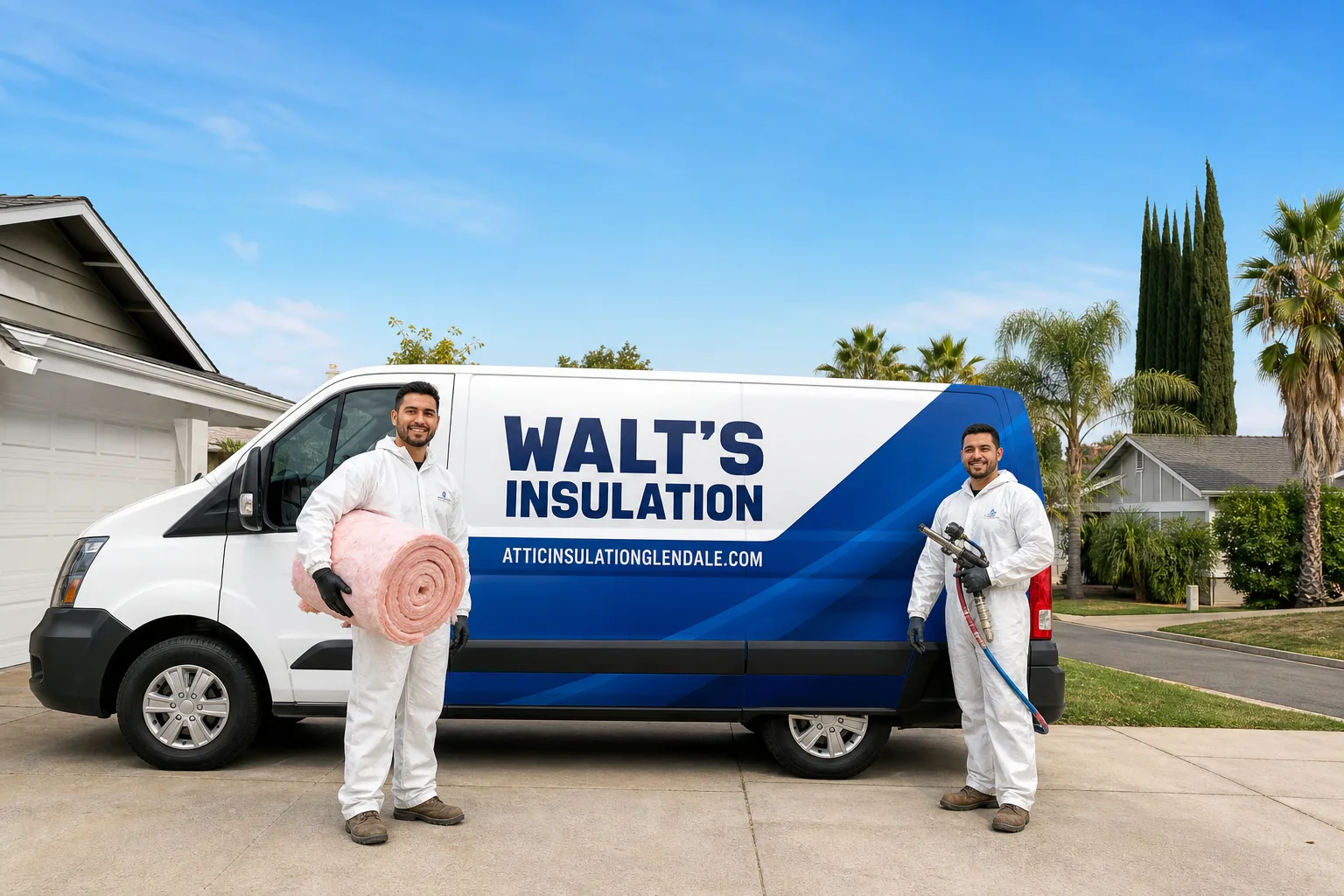
How Much Does Spray Foam Insulation Cost in Glendale?
Our Spray Foam Insulation services in Glendale, CA typically cost between $1.50 and $4.50 per square foot, depending on the type of foam, the area being insulated, and how accessible that area is for our crew. Most Glendale homeowners pay somewhere between $1,800 and $6,500 for a full project, though attic-only jobs in smaller homes can come in under $2,000 and whole-home encapsulation projects on larger properties in neighborhoods like La Crescenta-Montrose can reach $10,000 or more. Call (747) 246-7237 for a free, no-trip-charge estimate specific to your home.
Spray Foam Insulation Cost Breakdown (2026)
The numbers below reflect what Walt’s Insulation actually quotes in the Glendale market right now. These aren’t national averages pulled from a trade magazine – they account for Southern California labor rates, local permit costs where required, and the kinds of homes we see every week in Glendale, Montrose, and the Verdugo Hills area.
| Application Area / Project Type | Typical Cost Range (2026) | Notes |
|---|---|---|
| Attic (open-cell, 1,000 sq ft) | $1,400 – $2,800 | Most common Glendale attic job |
| Attic (closed-cell, 1,000 sq ft) | $2,800 – $5,200 | Preferred where moisture is a concern |
| Crawl space encapsulation + spray foam | $2,500 – $5,500 | Older Glendale bungalows often need this |
| Rim joists (per linear foot) | $3.50 – $7.00/LF | Closed-cell standard for air sealing |
| Interior wall cavities (open-cell) | $1.00 – $2.00 per sq ft | During remodel or new construction only |
| Garage ceiling / bonus room above garage | $900 – $2,200 | Popular in hillside properties |
| Full home air seal + spray foam package | $4,500 – $10,500+ | Larger homes in Rossmoyne, Glenoaks Canyon |
| Material only (open-cell, per board foot) | $0.44 – $0.65 | Labor typically doubles this number |
| Material only (closed-cell, per board foot) | $0.90 – $1.50 | Higher R-value per inch justifies cost |
What’s Included in These Prices?
Our quotes at Walt’s Insulation include materials, labor, basic prep (masking off electrical boxes and HVAC equipment), and cleanup. They do not include drywall patching if we’re accessing closed wall cavities, or any permit fees your specific job might trigger – we’ll tell you up front if a permit is needed so there’s no surprise at the end.
One thing that pushes Glendale pricing a bit higher than the national average: SoCal labor rates run about 15-20% above the U.S. median, and material transport costs here are real. Icynene and Demilec products – two of the foam systems we use regularly – have to be shipped and stored under temperature-controlled conditions, which adds a small but real cost that some contractors quietly bake into their per-square-foot rate without mentioning it. We itemize it so you know what you’re paying for.
Open-Cell vs. Closed-Cell: The Cost Difference Explained
Open-cell foam runs about half the price of closed-cell per board foot, which makes it the go-to for attic rafters and interior applications where moisture isn’t a driving concern. Closed-cell foam costs more because it’s denser, achieves a higher R-value per inch (around R-6 to R-7 per inch vs. R-3.5 for open-cell), and acts as a vapor barrier – which matters in Glendale’s hillside neighborhoods where crawl spaces and basement areas can pull in moisture from the Verdugo Mountains. For most Glendale attics, open-cell gets the job done. For crawl spaces, rim joists, and any area where water intrusion is even a remote possibility, we typically recommend closed-cell.
What Affects Spray Foam Insulation Pricing in Glendale
No two jobs price out the same, and a flat per-square-foot number only tells part of the story. Here’s what actually moves the needle on your final cost:
- Type of foam (open-cell vs. closed-cell): Closed-cell foam costs roughly twice as much per board foot as open-cell, but it delivers a higher R-value in less space and doubles as a vapor barrier. In Glendale’s hillside footprint – Verdugo Woodlands, La Crescenta, upper Montrose – that moisture resistance is often worth the extra spend.
- Square footage and thickness required: California’s Title 24 energy code sets minimum R-values that affect how thick we need to spray. Glendale falls in Climate Zone 9, which requires R-38 in attics – meaning you’ll need more material than a homeowner in a milder climate zone would.
- Accessibility and condition of the space: Low-clearance attics (common in the 1940s-1960s ranch homes along Chevy Chase Drive and Grandview Avenue) take longer to spray because our technicians are working in tight quarters. If there’s existing blown-in insulation that needs removal first, that’s a separate line item – typically $1.00 to $2.50 per square foot for removal alone.
- Old insulation removal: Many Glendale homes still have fiberglass batts or cellulose that has settled, been disturbed by pest activity, or simply reached the end of its useful life. If we’re spraying over a surface that needs to be cleared first, removal costs add to the total. We always check for rodent contamination before recommending what stays and what goes.
- Air sealing scope: Spray foam inherently air-seals as it expands, but if your home has significant bypasses around can lights, plumbing chases, or attic hatches, we may recommend a dedicated attic air sealing pass before applying foam. This is common in Glendale’s older craftsman and Spanish Colonial homes where original construction left a lot of air pathways open. Adding that step typically runs $400-$900 for a medium-sized home.
- Permit requirements: Glendale’s Building and Safety Division requires permits for certain insulation work, particularly when the project touches the building envelope in ways that affect fire code compliance. Spray foam on the underside of roof sheathing (unvented attic assemblies) often triggers a permit requirement. We handle the paperwork – but the fee, currently between $150 and $400 depending on project scope, is a pass-through cost.
A Note on Glendale’s Climate and Why It Matters for Foam Choice
Glendale sits in a Mediterranean climate that gets pushed around by the Santa Ana winds every fall, with temperature swings that can hit 30 degrees in a single day when those offshore winds come through. That thermal cycling stresses building envelopes in ways that cheaper insulation types can’t always handle. We regularly see attics in the Montecito Park and Foothill Knolls areas where fiberglass batts have shifted and air-leaked for so long that the homeowner’s HVAC system is fighting a losing battle year-round. Spray foam, because it expands into gaps and bonds to the substrate, holds up to that kind of thermal movement better than any other insulation type we install.
How to Save on Spray Foam Insulation in Glendale
Spray foam is not the cheapest insulation per square foot – and we won’t pretend otherwise. But there are real ways to reduce your out-of-pocket cost without cutting corners on the installation itself.
Use Available Rebates and Tax Credits
The federal energy efficiency tax credit under Section 25C still applies in 2026, covering up to 30% of the installed cost of qualifying insulation, with an annual cap of $1,200. For a $4,000 spray foam job, that’s potentially $1,200 back at tax time. Southern California Edison and SoCalGas also offer rebates for qualifying home insulation improvements – SoCal Edison’s rebate programs for Glendale customers have historically offered $0.10 to $0.25 per square foot for attic insulation upgrades, though you’ll want to confirm current program availability when you call us, because these programs open and close depending on funding cycles. We help customers identify which rebates apply before the job starts, not after.
Bundle Work When You Can
Mobilization – getting the crew, equipment, and materials to your home – is a fixed cost regardless of how many square feet we spray. If you’re planning to do your attic now and your crawl space next year, doing both in one visit can save you $300-$600 in mobilization alone. Same goes for combining spray foam with Spray Foam Insulation in Glendale service calls that include attic air sealing or insulation removal.
Get a Second Opinion on Any Existing Estimate
We offer a free second opinion on any written estimate you’ve received from another contractor – no charge, no obligation, no sales pressure. If another company quoted you $7,000 for an attic job that we think should run $4,500, we’ll tell you exactly why the numbers are different. Sometimes it’s scope, sometimes it’s foam type, and sometimes it’s margin. You deserve to know which one it is before you sign anything.
Ask About Our Standing Discounts
Seniors and veterans get 10% off, always – that’s not a limited-time promotion, it’s just how we operate. On any repair job over $200, there’s a standing $40 discount. And there’s no trip charge for homes inside Los Angeles County. These aren’t coupons we hand out to close a deal; they’re standing offers that apply every time.
Don’t Over-Specify the Foam Type
Closed-cell foam is the right call for certain applications, but not every application. If a contractor is quoting you closed-cell everywhere without explaining why, push back. For a standard Glendale attic rafter application, open-cell foam from a manufacturer like Icynene will hit your R-value target at roughly half the material cost. We’ll always tell you which foam type matches your actual situation – not the one that pads the invoice.
For a free estimate with no trip charge and no pressure, call (747) 246-7237. A live person picks up, 24/7.
Is Spray Foam Worth the Higher Upfront Cost in Glendale?
This is the question we get more than any other, and the honest answer is: usually yes, for the right home and the right application.
Glendale’s electricity rates through LADWP run higher than the national average, and if your home is in one of the hillside zip codes (91208, 91214) where summer attic temperatures routinely hit 140-160°F, an uninsulated or under-insulated attic is costing you real money every billing cycle. We’ve had customers in the Verdugo Hills area report $90-$140 monthly drops in their summer cooling bills after a full attic spray foam installation – savings that, on a $4,000 job, produce a payback period of roughly 3-4 years. After that, it’s pure return.
Spray foam also adds measurable air barrier performance that blown-in insulation and batts simply don’t provide. Glendale’s older housing stock – a lot of which was built between 1920 and 1960 – leaks air through every penetration, every ceiling joist gap, every improperly capped can light. Addressing those leaks with spray foam is a one-time fix that doesn’t settle, doesn’t shift, and doesn’t need to be redone in 15 years the way blown-in cellulose sometimes does.
For homes where the goal is comfort (not just energy savings), spray foam consistently outperforms other insulation types in eliminating hot spots, drafts, and the “stuffy upstairs” problem that’s endemic to Glendale’s two-story craftsman and Spanish Revival homes.
Spray Foam vs. Other Insulation Types: Cost Comparison for Glendale Homeowners
If you’re trying to figure out whether spray foam is the right call or whether blown-in or batt insulation would serve you just as well, this side-by-side gives you a realistic basis for comparison in the Glendale market.
- Spray foam (open-cell): $1.50-$2.50 per sq ft installed. Best for attic rafters, cathedral ceilings, unvented attic assemblies. Excellent air sealing. Not a vapor barrier.
- Spray foam (closed-cell): $3.00-$4.50 per sq ft installed. Best for crawl spaces, rim joists, areas with moisture risk. High R-value per inch. Acts as vapor barrier.
- Blown-in cellulose (GreenFiber): $0.90-$1.60 per sq ft installed. Good thermal performance in flat attic floors. Does not air-seal. Can settle over time. Better as an add-on than a standalone solution in leaky homes.
- Blown-in fiberglass (Owens Corning, Johns Manville): $1.00-$1.75 per sq ft installed. Similar performance to cellulose, lighter weight, less moisture absorption. Also does not air-seal.
- Fiberglass batt (CertainTeed, Knauf): $0.50-$1.25 per sq ft installed. Lowest upfront cost. Works well in new construction with clean framing bays. In older Glendale homes with irregular framing, air gaps reduce effective R-value significantly.
For a home where the attic is the primary concern and the framing is relatively clean, blown-in with a dedicated air sealing pass often delivers 80% of spray foam’s performance at 50-60% of the cost. We’ll tell you honestly which approach makes sense for your specific situation – that’s the kind of conversation you get when you call a locally owned business rather than a volume installer. You can learn more about what we do across all our services on our home page.
FAQs – Spray Foam Insulation Cost in Glendale
How much does spray foam insulation cost per square foot in Glendale, CA?
Spray foam insulation in Glendale costs between $1.50 and $4.50 per square foot installed, depending on whether you’re using open-cell or closed-cell foam and the complexity of the application. Open-cell runs $1.50-$2.50 per square foot for most attic applications; closed-cell runs $3.00-$4.50 per square foot for crawl spaces, rim joists, and moisture-sensitive areas. For an exact number based on your home’s square footage and layout, call (747) 246-7237 – estimates are free and there’s no trip charge inside Los Angeles County.
Is spray foam insulation cheaper than blown-in in Glendale?
No – spray foam costs roughly two to three times more per square foot than blown-in insulation at the point of installation. Blown-in cellulose or fiberglass runs $0.90-$1.75 per square foot installed in Glendale, while open-cell spray foam starts at $1.50 and closed-cell at $3.00. That said, spray foam also functions as an air barrier, which blown-in does not. In a leaky Glendale home, the air sealing value of spray foam often makes up the cost difference through energy savings within 3-5 years. We can run a side-by-side comparison for your specific home – just call and ask.
Does spray foam insulation require a permit in Glendale, CA?
It depends on the scope of work. Glendale’s Building and Safety Division typically requires a permit when spray foam is applied to the underside of roof sheathing to create an unvented attic assembly, as this changes the building’s thermal and moisture envelope in ways that affect code compliance. Standard attic floor or crawl space applications may not require a permit. We assess permit requirements as part of every estimate and handle the application process on your behalf. The permit fee itself – currently $150-$400 for most residential insulation projects in Glendale – is a pass-through cost we itemize separately so there’s no surprise on the invoice.
How long does spray foam insulation last in Glendale?
Spray foam insulation, properly installed, has an effective lifespan of 80 years or more – it doesn’t settle, compress, or lose R-value the way fiberglass batts and loose-fill can over time. In Glendale’s climate, the bigger risk isn’t foam degradation; it’s UV exposure on any foam left uncovered (open-cell foam must be covered with a thermal barrier like drywall within 15 days of installation per California code). All work we do at Walt’s Insulation is covered by the Done Right Promise – a lifetime workmanship guarantee that means if something isn’t right, we come back and make it right. No runaround.
Can I get spray foam insulation installed the same week I call in Glendale?
In most cases, yes. Our typical scheduling window for Glendale and surrounding communities runs 3-7 business days from estimate approval to installation date, though urgent situations – a failed inspection, a sale contingency, a roof replacement that needs insulation coordination – can sometimes be moved faster. The best way to check current availability is to call (747) 246-7237 directly. A live person picks up every time, around the clock, and can tell you exactly what the schedule looks like right now – not after you fill out a form and wait for a callback.
What’s the best type of spray foam for a Glendale attic?
For most Glendale attic applications – particularly the flat-ceiling attics common in the city’s ranch and mid-century homes – open-cell spray foam applied to the attic floor or rafter underside delivers strong thermal performance at a lower material cost than closed-cell. Open-cell products from manufacturers like Icynene and Demilec are what we use most often in attic rafter applications here. If the attic has any history of roof leaks, moisture intrusion, or pest damage, we may recommend closed-cell for its vapor-barrier properties. We’ll make that call based on what we actually see in your attic, not based on which foam has better margins for us.
Why Glendale Homeowners Choose Walt’s Insulation
Walt Brenner started this company in 2000 with a straightforward idea: do the work right, be honest about what it costs, and stand behind it without excuses. That’s still the whole business model, 25 years later.
We’re not a franchise. We’re not a call center with subcontracted crews. When you call (747) 246-7237, a real person answers – at 2 p.m. or 2 a.m. – and when we show up at your door, you get background-checked, uniformed technicians who work for Walt’s, not for a staffing agency. Walt Brenner’s name is on the company, which means his reputation is on every single job we do in Glendale, Montrose, La Crescenta, and the surrounding communities.
The Done Right Promise covers every installation we do, for life. If something we installed isn’t performing the way it should, we come back and fix it. Not after three service tickets and an escalation call – just a phone call and a return visit. That’s the whole policy.
We work with materials from manufacturers we trust: Owens Corning, Johns Manville, Icynene, Demilec, Knauf, Rockwool, CertainTeed, and GreenFiber. Not because we’re sponsored by them, but because we’ve installed enough insulation over 25 years to know which products hold up and which ones look good in a brochure.
If you’ve already got a written estimate from another contractor, call us before you sign it. The second opinion is free, and it takes about 30 minutes. A lot of Glendale homeowners have been surprised at what a second set of eyes finds – either in the scope, the foam type specified, or the pricing itself.
Key Takeaways: Spray Foam Insulation Cost in Glendale (2026)
- Open-cell spray foam runs $1.50-$2.50 per sq ft installed; closed-cell runs $3.00-$4.50 per sq ft in the Glendale market.
- Most Glendale homeowners spend $1,800-$6,500 for a typical spray foam project; larger or more complex homes can exceed $10,000.
- Glendale’s Climate Zone 9 designation and California’s Title 24 code affect minimum R-value requirements – your project scope is tied to those numbers, not just preference.
- The federal 25C tax credit covers up to 30% of qualifying insulation costs (up to $1,200/year) – ask about this before you start.
- Seniors and veterans receive a permanent 10% discount. No trip charge inside Los Angeles County. Free second opinion on any written estimate.
- All work is covered by the Done Right Promise – Walt’s lifetime workmanship guarantee.
- Permit requirements in Glendale vary by project type – we assess and handle permit applications as part of the job.
Get a Free Spray Foam Insulation Estimate in Glendale
If you’re ready to stop guessing at costs and get a real number for your specific home, call Walt’s Insulation at (747) 246-7237. We serve Glendale and the surrounding communities – Montrose, La Crescenta, Verdugo Hills, and throughout Los Angeles County – with no trip charge for the estimate and no pressure to commit on the spot. A live person answers every call, day or night. You can also reach us through our website to request a callback at a time that works for you.
We’re the one down the road – locally owned since 2000, with a real address, a real license number, and a real person on the other end of the phone.
Pricing reflects the Glendale market as of 2026. Walt’s Insulation offers free estimates – call (747) 246-7237.
Written by Walt Brenner, Owner at Walt’s Insulation, serving Glendale, CA since 2000.
What Our Customers Say
"Good honest work on the attic. The price was a little higher than one online quote, but Walt is the one who actually showed up and the one whose name is on the truck, and that was worth it to us."
- Helen Tran"We had the walls of our old house filled with foam through small holes from the outside. Patched and painted the same afternoon. The bedrooms hold heat now and the furnace runs a lot less."
- Linda Baumgartner"Air sealing first, then blown-in over the top. He found a bathroom fan venting straight into the attic and fixed that too. Written price before they started, same price when they finished."
- Arjun Mehta